







|
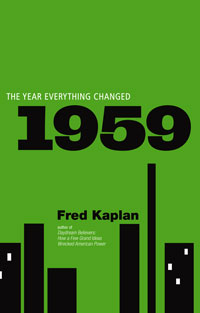
1959: The Year Everything Changed
A Washington Post Best Book of 2009
It was the year of the microchip, the birth-control pill,
the space race, and the computer revolution; the rise of Pop art, free
jazz, “sick comics,” the New Journalism, and indie films;
the emergence of Castro, Malcolm X, and personal superpower diplomacy;
the beginnings of Motown, Happenings, and the Generation Gap—all
bursting against the backdrop of the Cold War, the fallout-shelter craze,
and the first American casualties of the war in Vietnam. Drawing on original research, untapped archives, and interviews with major figures of the time, Fred Kaplan pieces together the vast, untold story of a civilization in flux—and paints vivid portraits of the men and women whose inventions, ideas, and energy paved the way for the world we know today.
Praise for 1959: The Year Everything Changed
Read the review in the Washington Post
Read another review in the Washington Post
Read the review in the Wall
Street Journal
Read George Packer's review-blog in The New Yorker
Read Richard Lacayo's blog-review in Time
Read George Will's review-column in the Washington Post
Read the review in Daily
Kos
Read the review in Wired
Read the review in the Louisville Courier-Journal
Read the review in the Washington Times
Read the review in the Toronto Sun
Read the review in Publisher's
Weekly
Read Tyler Green's blog review in Modern Art Notes
Read the review in The Onion A.V. Club's "Best Books We Read in 2009"
Read the review in Art & Antiques
Read the praise by Femi Kuti
"Fascinating...a cabinet of wonders... Those who love the AMC series Mad Men, set just after the epochal year, will find much to love in Kaplan's book." Los Angeles Times
"Clever...Fun...Kaplan makes an intriguing case that 1959 was an authentic annus mirabilis." The Wall Street Journal
"Enormously engaging...Kaplan is wonderful at chronicling what changed and how." The Washington Post
"Immensely enjoyable reading...A first-rate book." GEORGE PACKER, The New Yorker
"A must-read." Art & Antiques
"This sprawling, holistic joy of a book explores, expands, and provokes reassessment of an entire era—not just a year—in a way that is deeply satisfying and enlightening. Social, political, and historical commentary doesn't get much better than this."
Daily Kos
“1959 is a riveting account of the year our
modern age began. Everything did change, and you’ll be
amazed by how much was going on, and how much it has affected the way
you live your life now.”
KEVIN BAKER, author of Striver’s Row, Dreamland,
and Paradise Alley
"An engrossing story about not just where the
'60s came from but the birth of the future. Kaplan does a masterful job
of weaving together the strands - in politics, society, culture, and science
- that have brought us to the post-modern age."
JONATHAN ALTER, Newsweek columnist and author of The Defining
Moment: FDR’s Hundred Days and the Triumph of Hope
"Take a ride on the New Frontier with Fred Kaplan,
your insightful (and hip) guide to the space race, thermonuclear war,
the civil rights movement, the 'sick comics,' the Beats and the beginnings
of the Vietnam War, all to a soundtrack by Dave Brubeck, Ornette Coleman,
Miles and Motown."
DONALD FAGEN, co-founder, Steely Dan
“It turns out there’s only one degree of separation
between Miles Davis, the brilliant jazz innovator, and Herman Kahn, the
Strangelovian nuclear-war theorist—and his name is Fred Kaplan.
No one else could throw this fabulous cocktail party of a popular history,
teeming with defiant hipsters, visionary inventors, artistic rulebreakers,
and troublemakers of all kinds.”
HENDRIK HERTZBERG, senior editor, The New Yorker